Queer Places:
Church of the Intercession, 550 W 155th St, New York, NY 10032, United States
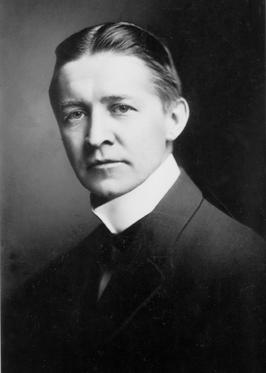 Bertram Grosvenor Goodhue (April 28, 1869 - April 23, 1924) was born on April 28, 1869, in Pomfret, Connecticut, to Charles Wells Goodhue and Helen
Grosvenor Eldredge Goodhue. Raised in modest financial circumstances, he was initially educated at home by his mother before attending Russell's
Collegiate and Commercial Institute at age eleven. Because formal university training was financially out of reach, Goodhue moved to Manhattan in 1884 to
apprentice at the prominent architectural firm of Renwick, Aspinwall & Russell, working under James Renwick Jr., the architect of St. Patrick's
Cathedral. His apprenticeship concluded in 1884 when he won a design competition for St. Matthew's in Dallas, marking the true beginning of his
professional career.
Bertram Grosvenor Goodhue (April 28, 1869 - April 23, 1924) was born on April 28, 1869, in Pomfret, Connecticut, to Charles Wells Goodhue and Helen
Grosvenor Eldredge Goodhue. Raised in modest financial circumstances, he was initially educated at home by his mother before attending Russell's
Collegiate and Commercial Institute at age eleven. Because formal university training was financially out of reach, Goodhue moved to Manhattan in 1884 to
apprentice at the prominent architectural firm of Renwick, Aspinwall & Russell, working under James Renwick Jr., the architect of St. Patrick's
Cathedral. His apprenticeship concluded in 1884 when he won a design competition for St. Matthew's in Dallas, marking the true beginning of his
professional career.
Following his time in New York, Goodhue relocated to Boston, Massachusetts. There, he immersed himself in the city's vibrant artistic and intellectual
circles, joining groups like the Society of Arts and Crafts, the "Pewter Mugs," and the "Visionists," and co-founding the short-lived quarterly art
magazine The Knight Errant. Crucially, Goodhue became enmeshed in Boston's elite bohemian social infrastructure, maintaining close ties to exclusive
homosocial venues like The Tavern Club. Within these sophisticated circles, he associated with prominent gay and queer cultural figures of the era,
including John Singer Sargent, Henry James,
George Santayana, and Sturgis Bigelow. His association
with these artistic communities brought unique personal scrutiny; as his architectural partner Charles Wentworth warned him and
Ralph Adams Cram in 1895, their bohemian circles and "queer" status invited professional risks in the wake
of Oscar Wilde's sensationalized trial and downfall. Despite these societal undercurrents, Goodhue married Lydia
Thompson Bryant Kimball in 1902, with whom he had two children, Frances and Hugh.
In 1891, Goodhue formed a legendary architectural partnership with Ralph Adams Cram, later joined by Frank Ferguson to establish Cram, Goodhue &
Ferguson. For nearly twenty-five years, the firm dominated the American architectural landscape as a premier leader in Neo-Gothic design, crafting
monumental ecclesiastical, academic, and institutional projects. Among their most celebrated joint works are the United States Military Academy at West
Point, the Gothic Revival Saint Thomas Church on Fifth Avenue, the Church of the Intercession in Manhattan, and the Rockefeller Chapel at the University
of Chicago. Beyond his architectural blueprints, Goodhue was an accomplished multitalented designer who created notable typefaces, including Cheltenham
(which became the headline font for The New York Times) and Merrymount for the Merrymount Press.
In 1914, Goodhue departed from Cram to establish an independent practice, moving away from strict Gothic revivals into radically different stylistic
experiments. His independent portfolio began with the Byzantine Revival style for St. Bartholomew's Episcopal Church on Park Avenue in New York City.
Soon after, he pioneered the Spanish Colonial Revival style, most famously masterminding the El Prado Quadrangle layout and buildings for the 1915
Panama–California Exposition in San Diego's Balboa Park. This Spanish Baroque and Churrigueresque-inspired aesthetic profoundly influenced regional
architecture across California and Hawaii. His influential private residential commissions from this era include the Persian-garden-inspired El Fureidis
and Dias Felices in Montecito.
Towards the end of his life, Goodhue transitioned toward a highly personal, simplified, and archaic modern idiom that integrated sculpture, murals,
and mosaics, paving the way for twentieth-century architectural modernism. His final masterpieces included the Los Angeles Public Library, the National
Academy of Sciences Building in Washington, D.C., and the towering art deco-influenced Nebraska State Capitol. He was elected an Academician of the
National Academy of Design and received membership in the American Academy of Arts and Letters. Bertram Goodhue died unexpectedly on April 23, 1924, in
New York City, just days before his fifty-fifth birthday. Honoring his specific wish to rest within the building he considered his finest achievement, he
was interred inside a wall vault at the Church of the Intercession, beneath a custom Gothic tomb designed by his frequent collaborator, architectural
sculptor Lee Lawrie. Posthumously, Goodhue was awarded the AIA Gold Medal in 1925, leaving behind a monumental legacy that fundamentally shaped American
architectural identity.
References:
Other references:
- Oliver, Richard. Bertram Grosvenor Goodhue . Cambridge, Massachusetts: MIT Press, 1983. (Published for the Architectural History Foundation; includes a comprehensive bibliography and index).
- Whitaker, Charles Harris, ed. Bertram Grosvenor Goodhue: Architect and Master of Many Arts . New York: Press of the American Institute of Architects, Inc., 1925. (Reprinted by Da Capo Press, 1976), featuring text contributions by associates such as Hartley Burr Alexander, Ralph Adams Cram, George Ellery Hale, Lee Lawrie, and C. Howard Walker.
- Wyllie, Romy. Bertram Goodhue: His Life and Residential Architecture . New York: W. W. Norton & Company, 2007.
- Avery Architectural and Fine Arts Library, Columbia University. Bertram Grosvenor Goodhue Architectural Drawings and Papers, 1882–1980 . (An extensive archival collection comprising personal and professional correspondence, project records, photographs, and architectural drawings housed in the Department of Drawings & Archives).
- McCall, Wayne, Herb Andree, Noel Young, and Patricia Halloran. Santa Barbara Architecture: From Spanish Colonial to Modern . Santa Barbara: Capra Press, 1980.
- Aran, Berge. Austin Val Verde, a Montecito Masterpiece . Santa Barbara: Austin Val Verde Foundation, 2005.
Support this project
This website is a passion project researched, developed, and funded entirely by me. If you find the content valuable and would like to help support the ongoing research and hosting costs, any contribution is deeply appreciated.
Thank you for keeping this independent resource alive!
My books on Amazon: Elisa Rolle's books
BACK TO HOME PAGE